
Listicles – short, easy-to-read articles made up of numbered points, are popular because they are effective. If you’re writing for a blog, newsletter, or social media, listicles can make complex subjects easier to understand.
They break the information into smaller parts, so readers can grasp and share your content more easily. Although they might seem easy, creating a really good listicle requires more than just putting together some random tips.
A bad structure, weak ideas, or unnecessary content can make a good piece of writing something that readers quickly leave. How do you create a listicle that is interesting and trustworthy? One that gives useful information without being lazy or repetitive?
This post will show you how to plan, write, and improve a listicle content that catches people’s attention and keeps them interested. Whether you’re new to creating content or have experience in marketing, these tips will help you write better listicles that really connect with your audience.
What is a Listicle?
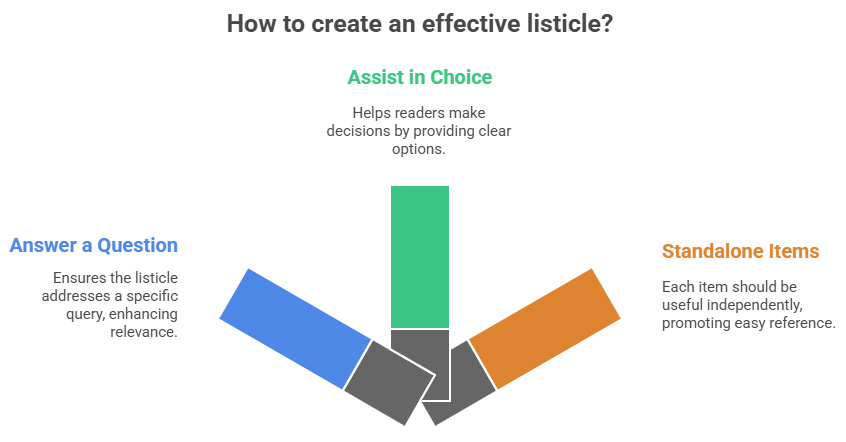
It is a type of blog post that is set up like a list. Each item talks about a part of the topic, and when you put them all together, you get the complete understanding. It’s not just about putting random numbers on tips. A good listicle is an easy and organized way to give helpful information. The best ones do three main things:
- Answer a particular question.
- Assist readers in making a choice.
- Make sure each item can be helpful by itself.
They’re simple to read, simple to share, and simple to reference. If someone can take a screenshot of something and find it useful, that’s a true listicle. If they need to read everything to get it, you haven’t done it right. Listicles work best when each item deserves to be there. If it’s unnecessary, remove it.
Also Read: 7 Killer Tricks to Repurpose Your Content and Optimize Your SEO Strategy
7 Easy Steps to Write Great Listicle Content
There’s no single solution that works for everyone. If you want more visitors, links, and shares, begin by choosing a good topic and make sure your content is organized to provide value quickly. No matter if you’re writing for a blog, or social media, using the right list style can increase clicks and make your content perform better.
Step 1: Pick the Right Format and Topic
Not every topic needs to be in a list. Listicles are most effective when people want to compare choices or find quick information. If someone is asking “what is the best,” “top tools,” or “how to fix,” that means you should go ahead. Here’s when it makes sense to use a list:
- People are looking at options and making choices.
- Featured snippets on the search results page are shown in a list format.
- Posts that compete use numbers in their titles.
- You’re gathering advice, ideas, or tools.
If you’re creating a plan for your content that focuses on popular keywords, take a look at the results page. If many of the best results are lists, use that same style. If they are guides, outlines, or personal views, follow that path instead.
Headlines that list things work better. Anyword found that 70% of listicle titles got more clicks than regular titles. Putting a number in a Facebook headline made it work better. The way you organize a headline is important.
Step 2: Choose the Right Structure and Number
There isn’t a perfect number, but odd numbers are more interesting. “Top 13” is often better than “Top 10”. What’s more important is how deep and organized it is. Don’t force a weak list to reach 25. Make it neat and to the point. Please use one of these types:
- Brief and thorough: 5 to 7 fully explained strategies.
- Grouped: 12 tools, sorted by type or how to use them.
- Ranked: 10 items listed with benefits and drawbacks
Every item should provide something helpful, even if it’s not in the right situation. If it can’t stand on its own, it doesn’t fit in. How can you tell if an item on a list is separate. Just think about:
- If you took away the rest of the post, would this item still be helpful?
- Can someone take a screenshot of this part and find it helpful without reading anything else?
Ahrefs has a list of 14 top SEO Chrome extensions. They are organized by type and include pictures and examples of how to use them. Clear and easy to read. A 1,500-word list with 5 good points is better than a long 3,000-word article. Focus on being clear, not on the number of words.
Step 3: Highlight the Benefits Upfront
Most readers won’t read beyond the first few points on the list. The top 3 to 4 items get the most clicks, shares, and rankings. Begin with confidence. Here’s how to do front-loading well:
- Start with something surprising.
- Share a helpful fact or example right away.
- Begin with the strategy that many people overlook or get wrong.
This isn’t about keeping the best part until the end. It’s about catching people’s attention quickly and building trust with them as they keep looking. Eye-tracking studies show that people pay attention to the top half of your list three times more. That’s where it really matters, especially if you’re posting it on social media.

Step 4: Make it Worth Linking To
If someone uses your list instead of making their own, that’s a success for you. That’s how list articles get links and keep appearing in roundups, discussion boards, and newsletters. Make your post easy to share by adding useful information:
- Add original pictures, diagrams, or graphs.
- Provide statistics with source links.
- Add quotes or quick opinions from trusted experts.
- Use links to other blog posts or tools that are connected.
- Add special ideas to each list item, not just extra words.
In content marketing, the simplest way to get links is to make something that people don’t want to create again. Backlinko’s list of factors that affect Google rankings is made for references. It’s lengthy, well-researched, and set up for easy reuse.
Step 5: Make it Easy to Read and Share
Listicles are simple to read quickly, so how they are set up is more important than how long they are. Here’s your list of things to do:
- Use H2 or H3 headings for each item in the list.
- Write the main points in bold.
- Make list items brief, no more than 3 to 5 sentences.
- Add screenshots, pictures, or short videos.
- Use the same format every time: Problem ➔ Solution ➔ Tip or Tool ➔ Why It’s Important ➔ Example.
If someone takes a screenshot of one item from the list, it should still make sense by itself. This helps make your content easier to share on social media or put on a landing page for reuse. Zapier’s list of AI tools for productivity does a great job. Each tool has a brief description, highlighted features, and a picture. You can copy and share any part and still benefit from it.
Step 6: Optimize for Search Engines (and AI Summaries)
Listicles are great for getting featured snippets if you do them correctly. They’re appearing more in AI-generated summaries in Google’s new search features. We looked at more than 2,000 requests in Google’s AI Mode. Blog posts were the most common type of content, making up 49%.
That’s an important message. If your blog is well-organized and has helpful information that is referenced, AI is more likely to use it. Here’s how to make your list article better for search engines and AI:
- Start your content with a lead.
- Use H2 or H3 headings for each item in the list.
- Add itemList or FAQPage structure when it’s appropriate.
- Add descriptive text to your images using important words, not just random ones.
- Write a simple summary that includes how many items there are and what benefits they offer.
- Use clear and direct language, with sources for your facts, especially at the beginning and in the main points.
Include links for each item or a summary list at the end. This gives you another chance to have a highlighted answer and helps readers find their way better.
Step 7: Create a Call to Action That Maintains the Momentum
Don’t finish with “leave a comment below”. That’s unoriginal and doesn’t help the reader. The right call to action keeps things moving smoothly. It should feel like a treat, not a sales talk. Give these a try:
- Ask a question like: Which method will you try out first?
- Provide a checklist that can be downloaded.
- Add a quick, and useful prompt
- Share a link to your helpful guide, tool, or video if they want more information.
Make sure your call to action feels like a bonus for the reader, not just a sales pitch. For example, you can add, “Get this (blog post checklist) if you want to make your draft ready to share”.
Also Read: Top 5 Tips for Crafting Good Seasonal Content in Any Niche
Common Mistakes to Avoid in Listicle Content
Repeating Information
One frequent mistake in listicles is adding several items that mean the same thing but are just worded differently. This often happens when you want to reach a specific number, like “10 productivity tips,” but you only have 6 or 7 good ideas.
To take up space, writers often restate a previous suggestion, believing it sounds new. For example, “Be consistent with your content” and “Post often to gain momentum” seem like different tips, but they have the same main message.
This makes you less credible and takes up the reader’s time. Readers look for clear and helpful information in listicles, not the same points repeated. Instead, make sure each point adds something new, like a different perspective, or more details. If two tips are too alike, merge them or get rid of one.
Adding Tools That You Haven’t Used or Checked
Lists that suggest useful tools, websites, or methods can be very helpful, but only if they are reliable. One big mistake is including tools that you have never used or tried yourself.
It may be attractive to add some popular names to make your list seem complete or current, but if you can’t back them up with facts, you could be taking a chance. What if the tool has problems, is old, costs too much, or doesn’t work well.
Even worse, you could end up suggesting something that goes against the advice you’re giving. This breaks trust and makes everyone on your list seem unreliable. Instead, use tools that you have tried yourself or that are strongly suggested by people you trust.
Also, be open about how much experience you have. If you haven’t used a tool but still want to mention it, say that it’s based on research or reviews from other people. Being authentic is always better than just being popular in the long run.

Long Introduction
In listicles, readers want easy-to-read information quickly. A long introduction can be a real turnoff. A brief introduction can help explain things better, but too much background information or unnecessary comments just waste the reader’s time.
If someone clicks on “7 Tools to Boost Productivity,” they don’t want to read a long history about workplace efficiency. This extra content often comes from old SEO practices or the belief that longer introductions make someone look more knowledgeable.
But in reality, it annoys readers and makes them leave the page quickly. A good tip is to keep your introduction short, using only 3 to 5 clear sentences. Clearly explain what the list includes, why it’s important, and who it is designed for, then begin.
You can always add more details in the main part or at the end. Keep in mind that people reading listicles often skim through them. If you make it easy for them to read, they’re more likely to stay and share your content.
Providing General Advice without Any Context
Basic tips like “Stay focused” or “Use social media” don’t provide much help without more explanation. Readers don’t want general advice in listicles; they want practical tips that are supported by examples, data, or real-life use.
Without these, your list seems boring and easy to forget. Anyone can tell you to “be yourself” or “work better,” but if they don’t show you how to do it, why it’s important, and what it actually looks like, you won’t remember it.
A good listicle should either teach the reader something they didn’t know or give them a new way to think about something they already know. Use small case studies, stats, or your own experiences to make each point better.
For example, instead of just saying “Use a calendar app,” you could share how using Google Calendar to block out time helped you or someone you know stay focused and avoid distractions. Details make you trustworthy and help people believe in you, while general advice gets lost in all the information online.
Creating a List That is Either Too Long or Short
A listicle works best when you pick the right number of items, not just a number that sounds good or is easy to remember. A list that is too short might seem hurried or not complete, making the reader wish for more information.
On the other hand, a very long list (like “101 tips for being productive”) can make people feel overwhelmed or tired, especially if many of the tips are similar or not very useful. The aim isn’t to reach a random number, it’s to provide an enjoyable experience.
Decide the length of the listicle based on the topic. A specific topic might only need 5 to 7 important points. A longer guide might have 15-20 items if each one gives new information. Always choose having good things instead of a lot of things.
If you’re trying to reach a certain number, think about reducing your list. If you’re leaving out valuable ideas just to match a title, try to include more information. The best listicles are simple, clear, and carefully chosen.
To Conclude
Creating a good listicle isn’t just about sticking to a set plan, it’s about valuing your readers’ time and providing helpful information in a way they like. When done well, listicles are a great way to teach, entertain, and get people interested.
To be noticed among many “Top 10” posts, you need more than eye-catching titles and lists. Focus on what really matters. Make sure each thing on your list is different, can be executed, and has examples or ideas to back it up.
Don’t use unnecessary words or repeat ideas just to make your content longer. Use formatting to help the reader, and keep your tone simple and friendly. Most importantly, write with a clear goal, your list should mean something, not just be a random count.
FAQs
How do I pick the best topic for a listicle?
The best listicle focuses on something your audience wants to know, needs help with, or is interested in. Find common problems, questions people often ask, or missing information in the current content. If people want to know how to stay focused while working from home, a list like “7 Tips for Being Productive at Home” could be helpful. Use keyword searches, input from your community, or your own knowledge to discover current and important topics.
Is there a perfect number of items to have in a list?
There’s no exact number that works for everyone, but the best list articles usually have between 5 and 15 items. The right length depends on your subject and how detailed each part needs to be. For example, the title “5 Ways to Make Your Writing Process Better” could work well if each suggestion includes a lot of examples. On the other hand, a bigger article like “21 Marketing Tools to Try in 2025” could be longer if each tool is special in its own way.
Should I share my personal experiences or stay neutral?
A combination of both usually works the best. Adding your own stories or experiences can make your list feel more real and easier for people to connect with, especially if your story backs up the advice you’re sharing. That being said, it’s also important to support your statements with clear reasons, examples, or outside information when you can. Readers value honesty. If you haven’t tried something yourself, be honest about it and base your opinion on research or reliable suggestions.
Can I include pictures, gifs, or videos in a listicle?
It’s a good idea to do so when it makes sense. Pictures divide big chunks of writing, keep readers interested, and make it easier to understand ideas quickly. Screenshots can help explain instructions, infographics can highlight important information, and gifs can bring humor or character to the message. Make them load quickly and easy to use by adding alt text and captions. Listicles with lots of images and videos usually do better, especially in areas like technology, productivity, design, and DIY projects.
How can I tell if my listicle is successful?
Success depends on what you want to achieve: Do you want more visitors, more interaction, more potential customers, or more shares? Keep track of the right metrics to measure your results. Use Google Analytics to check how long people stay on the page and if they leave right away. Check comments, shares, and links to see how people are interacting. If your list has things like asking people to subscribe or download, keep an eye on how many actually do it.